Monerium
How Monerium and Bebop bring scalable euro liquidity to DeFi

Services
Onchain EUR volume captured after integrating Bebop
50%
EURe's share of active Europe-issued stablecoin holders
82%
Assets held by Monerium
2
Assets accessible to EURe holders via Bebop
400+
“Bebop helps us distribute EURe liquidity across DeFi without fragmenting inventory across chains and pools. Instead of locking capital into idle liquidity, we can price directly into demand and deliver strong execution quality where users actually trade.”
– Arni, CPO, Monerium
Monerium issues EURe, a regulated euro stablecoin backed 1:1 by euros held in segregated EU bank accounts. In 2019, Monerium became the first company worldwide authorized to issue e-money on blockchain under an Electronic Money Institution (EMI) license from the Central Bank of Iceland.
EURe is MiCA compliant and integrated into products like Gnosis Pay and MetaMask Card, enabling users to spend onchain euros in everyday payments. To date, more than €8 billion in transaction volume has been settled using EURe, demonstrating growing demand for regulated euro stablecoin infrastructure.
Unlike most stablecoin issuers that rely largely on third-party market makers and liquidity pools to support liquidity, Monerium wanted to achieve capital efficiency and direct control over their market. The challenge was how to make EURe reliably tradable across venues and chains without spreading liquidity thin across pools.
For a stablecoin issuer, getting your token into the hands of users is only part of the challenge. The other is ensuring it can be traded reliably, at fair prices, and in meaningful size.
The default approach in DeFi is seeding liquidity pools on AMMs. But for euro stablecoins, that model quickly becomes inefficient. EUR-denominated pools onchain remain relatively shallow, meaning larger trades can create significant slippage. Supporting large trades requires locking significant capital into liquidity pools. Keeping onchain euro prices aligned with FX markets also requires constant arbitrage across venues.
Then there is the multi-chain problem. Monerium could spread its capital across AMM pools on different chains. But capital sitting in a pool on Arbitrum does nothing for a trader on Ethereum. Fragmented liquidity means idle capital on every chain where EURe is deployed.
The EUR stablecoin market is small relative to USD, under $1B in total market cap across all issuers. By market cap alone, EURe is not the largest euro stablecoin. But market cap tells you how much capital is parked, not how much is actually being used.
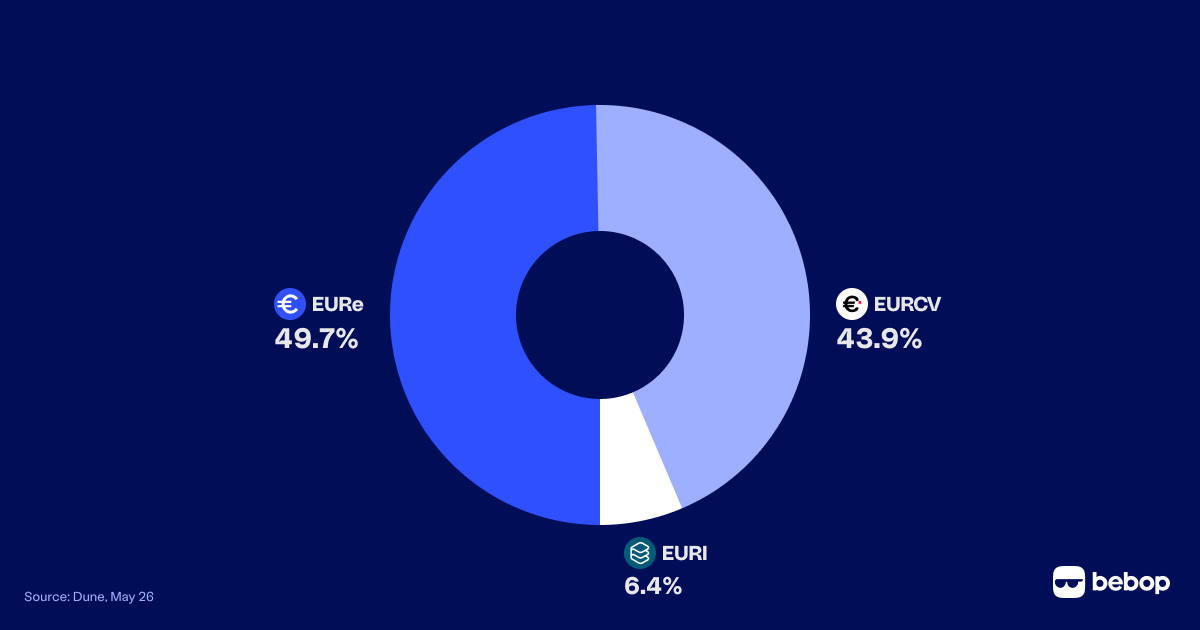
In Q1 2026, EURe represented nearly half of cumulative onchain EUR stablecoin transfer volume among European issuers, leading the market ahead of Société Générale Forge’s EURCV.
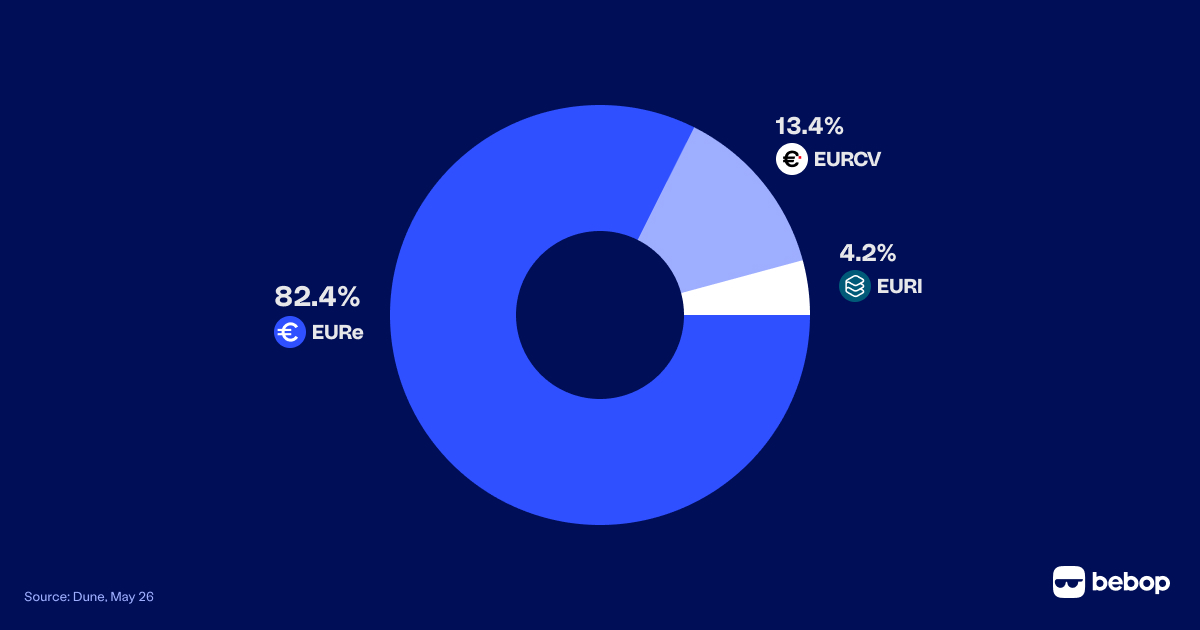
Active holder data tells a similar story. In Q1 2026, EURe represented roughly 82% of active EUR stablecoin holders among European issuers, indicating substantially broader onchain usage and distribution than competing assets.
What matters is not just how much supply exists, but how actively the token is used. Tokens that move regularly through the market tend to have deeper liquidity and better execution than tokens sitting idle in a few wallets.
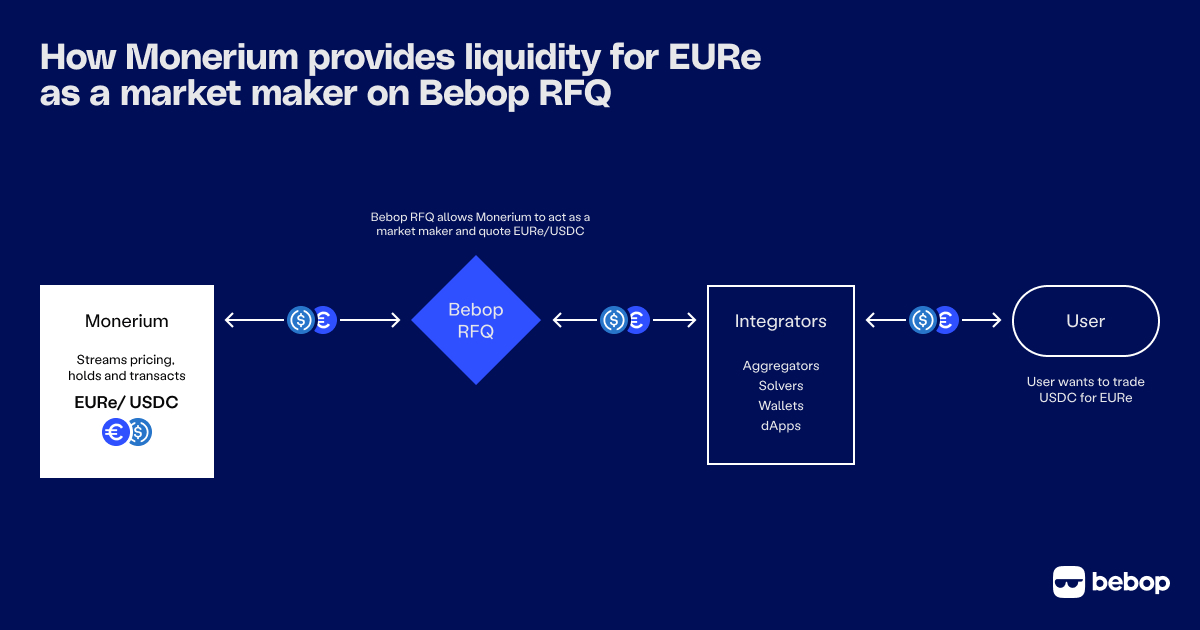
Monerium joined Bebop as a market maker for EURe, streaming firm quotes directly into the network alongside Bebop's professional market makers.
Thanks to RFQ capital efficiency, even with relatively modest deployed inventory, Monerium delivers tight pricing even for larger trades, including six-figure swaps. Reliable execution at size unlocks use cases beyond retail trading, including cross-border payments, FX settlement flows, treasury operations, and liquidation infrastructure for DeFi protocols.
Active holder data tells a similar story. In Q1 2026, EURe represented roughly 82% of active EUR stablecoin holders among European issuers, indicating substantially broader onchain usage and distribution than competing assets.
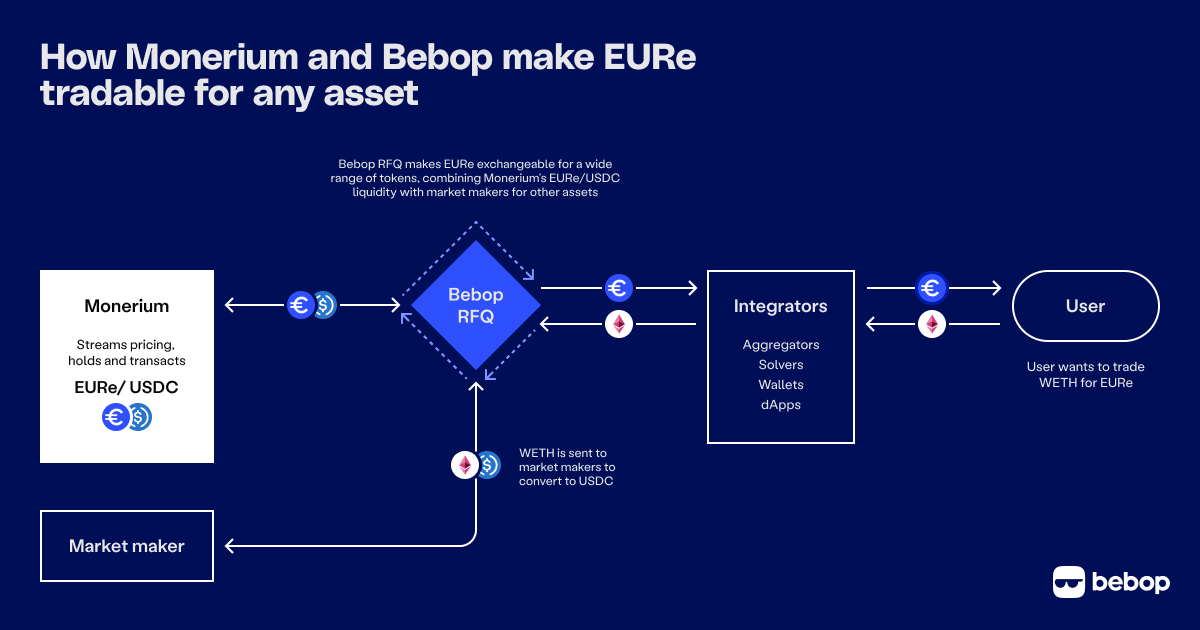
On every trade, Monerium's liquidity is aggregated with quotes from other market makers, which means that EURe is tradeable for a wide range of tokens like other stablecoins, ETH, WBTC and hundreds of other tokens.
Just like that, Monerium has full control over the high pricing quality and depth of market for EURe, while Bebop ensures the stablecoin is tradeable for any token all across DeFi.
Before integrating with Bebop, distributing liquidity across DeFi largely meant seeding and incentivizing pools on multiple venues. That model is expensive and difficult to scale efficiently. In practice, maintaining roughly $1 million in TVL can require well over $100,000 per year in incentives alone, before accounting for inventory fragmentation, operational overhead, and pricing inefficiencies.
With a single integration into Bebop, Monerium gains access to the broader aggregator and solver ecosystem without managing each venue relationship independently. Bebop handles distribution and connectivity across DeFi, while Monerium focuses on supplying liquidity, pricing, and execution quality.
Instead of locking capital into fragmented pools and ongoing incentive programs, liquidity can be deployed dynamically in response to real trading demand. For Monerium, the result is both tighter execution and a significantly more capital-efficient distribution model for EURe.
As stablecoins expand beyond simple transfers into payments, treasury flows, and onchain FX, liquidity infrastructure becomes increasingly important. Issuers need a way to provide reliable execution across chains and applications without fragmenting capital across isolated pools and venues.
By connecting through Bebop, issuers can distribute liquidity into the broader DeFi ecosystem through a single integration layer, making regulated fiat stablecoins usable wherever liquidity is needed. This creates a foundation for deeper onchain FX markets between regulated currencies like EUR, GBP, and USD across multiple chains and applications.
The model also opens the door for greater cooperation between issuers. Instead of competing through fragmented liquidity programs, issuers can contribute directly to more efficient onchain FX liquidity and settlement infrastructure that wallets, fintechs, payment providers, and DeFi applications can build on top of.
Monerium is now live with issuer-led liquidity for EURe on Ethereum through Bebop and plans to continue expanding liquidity depth and distribution as adoption grows. The next phase is bringing the same execution quality and onchain FX capabilities to additional chains and ecosystems where demand for regulated euro liquidity is emerging.
As EURe usage expands across wallets, payments, and DeFi applications, Monerium expects demand for regulated onchain FX between EUR, USD, and other fiat stablecoins to grow significantly. Integrations like Bebop make that liquidity accessible across aggregators, solvers, and applications through existing DeFi execution infrastructure.
Web3 payment integrations are also driving transactional usage of EURe. Products like MetaMask Card and Gnosis Pay bring regulated onchain euros into everyday payment flows, increasing settlement activity across both banks and blockchains.
Have your own stablecoin and want to make it accessible at scale?