Rhino
How Bebop became critical infrastructure for Rhino's crosschain swaps
Services
Integration time
<1 week
Swaps routed through Bebop on day 1
50%
Percentage of reverts via Bebop
0.004%
Rhino builds onboarding infrastructure for decentralized applications. Through its web app, API, and embeddable widget, users can bridge assets across chains, swap into the right token, and settle funds into a destination app. All in one transaction.
Today, 3 out of the top 10 perp DEXs rely on Rhino to handle deposits and settlements. What used to take users 3 or 4 separate steps now happens in a single click.
Onboarding becomes invisible to the end user and conversion rates go up for the application. By absorbing all of that complexity, Rhino provides a smoother experience for the end user. But this brings its own set of challenges.
The biggest one is zero margin for swap failures. Since Rhino combines multiple transactions into one, even a single step failing means the whole transaction reverts. That results in horrible UX.
As Rhino scaled its integrations with major perp DEXs, a reliability problem started showing up repeatedly.
Rhino's flow has three steps. An aggregator swaps the user's token into stables on the source chain. Rhino bridges those stables to the destination chain. A second aggregator swaps out of stables into whatever the destination app requires. Rhino handles the bridging, but the swaps on either end rely on traditional DEX aggregators. These aggregators simulate routes and make optimistic price assumptions. Inside a multi-step crosschain flow, each swap becomes a point of failure.
Cross-chain adds time. Prices move while assets are being bridged. Liquidity conditions shift between the moment a quote is generated and the moment it settles. Every additional step in the flow increases the chance of a slippage-induced failure. For aggregators relying on optimistic pricing, these delays are where things break.
For a regular same-chain swap, a revert is annoying. For an onboarding transaction that spans chains, it's fatal. A failed swap means the entire deposit flow breaks and the end user never makes it into the app.
Rhino needed a provider that guaranteed execution at the quoted price, every time.
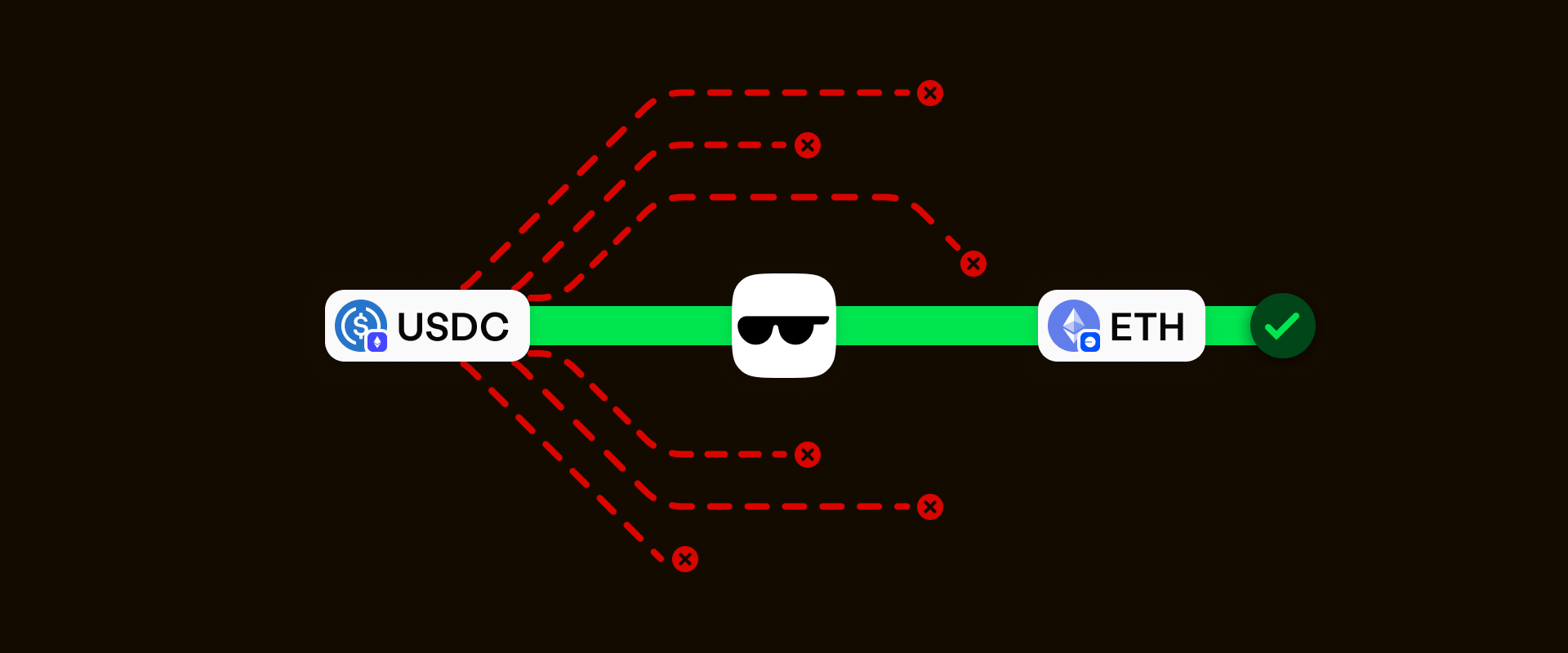
Bebop's RFQ+ API connects directly to professional market makers who provide firm, executable quotes on demand. The price quoted is the price executed.
Every quoted trade is filled. No reverts, no partial fills, no failed transactions. Quotes are returned and settled fast, which is crucial for onboarding flows where every second of delay adds risk.
Bebop's execution guarantees hold across hundreds of tokens, hundreds of millions in total liquidity, and multiple chains. The same reliability that works for a small ETH-to-USDC swap also holds for large stablecoin conversions and less liquid pairs. Coverage and depth are core to how the system works.
Rhino integrated Bebop in a week and the impact was immediate. Just within the first week, nearly 50% of all swap transactions on Rhino were being routed through Bebop. The routing logic recognized the execution guarantees and prioritized accordingly.
The result for Rhino's users: onboarding flows that previously broke due to slippage now complete reliably. No more failed deposits. No more lost users at the last step.
The volume concentrated in a small number of high-priority pairs: ETH/USDT, ETH/USDC and WBTC/USDC. These are the pairs that matter most for onboarding flows, and they are exactly where execution certainty is non-negotiable.
On these pairs, Bebop delivers deep, reliable liquidity sourced from professional market makers. Firm quotes, guaranteed fills, and predictable outcomes.
The pattern behind this integration applies to any application where a swap sits inside a broader workflow.
In general-purpose trading, users accept some execution risk in exchange for potentially better prices. That tradeoff makes sense when the swap is the end goal.
But when the swap is one step in a larger process, things change. A marginally better quoted price means nothing if the transaction fails. Every failed execution is a lost user and lost revenue for the application on the other side.
Any team building flows where swap failure has downstream consequences needs guaranteed fills at guaranteed prices. Onboarding, deposits, payroll conversions and in-app purchases are a few examples. Wherever a swap is a means to an end and not the end itself, execution certainty becomes the priority.
Rhino recently expanded into B2B infrastructure, offering its onboarding capabilities directly to applications and protocols. The partnership continues to deepen as Rhino identifies new swapping challenges on its roadmap, including stablecoin conversion flows for specific ecosystems where Bebop's guaranteed execution model is a natural fit.
As transaction complexity increases and reliability requirements tighten, Bebop remains Rhino's liquidity provider of choice.
Building an application where swap failures aren't acceptable?